





WHAT IS A MOONPHASE WATCH? A COMPLETE GUIDE FOR WATCH COLLECTORS
January 2nd, 2026


Moonphase watches are among the most poetic and visually captivating complications in horology. While they may look simple—a tiny moon tracing its orbit across a window on the dial—the engineering behind this feature can range from charmingly traditional to remarkably sophisticated. Below, we answer the most common questions collectors ask and explore how leading brands have elevated the moonphase into a true horological statement.


Q: What Is a Moonphase Watch
and How Does It Work?
A moonphase watch displays the current phase of the moon as seen from Earth—waxing, waning, full, or new. Traditional mechanical moonphase movements rely on a rotating disc, typically engraved with two moons, advancing once every 24 hours to approximate the lunar cycle of 29.5 days.
More advanced executions improve on this approximation. Patek Philippe, for example, has long been known for moonphase mechanisms that require correction only once every 122 years, as seen in references such as the Complications Ref. 5396R-011. Other high-complication pieces refine the gear ratios even further, pushing theoretical accuracy well beyond a human lifetime. Regardless of complexity, the enduring appeal lies in seeing celestial time rendered mechanically on the wrist.
Q: Are All Moonphase
Displays the Same?
Not at all. Some watches labeled as “moonphase” are, in fact, simple day/night indicators that complete a 24-hour rotation. A true moonphase tracks the lunar synodic month and advances in step with the moon’s actual orbit.
Among brands that take this distinction seriously, execution varies dramatically. Arnold & Son is particularly notable for its oversized moonphase displays, often occupying a dominant portion of the dial. In models like the HM Perpetual Moon, the brand uses a large, photorealistic moon that advances with impressive precision. Ulysse Nardin takes a different approach altogether, incorporating a three-dimensional moon sphere—an actual rotating orb with engraved craters—most famously in the Moonstruck and later moonphase complications. These are not decorative gestures; they are mechanically driven representations of lunar motion


Q: What Should I Look for
When Buying a Moonphase Watch?
Three factors matter most:
Movement Architecture:
Mechanical moonphases—manual or automatic—remain the benchmark for collectors. Beyond basic disc systems, look for refined gearing, integrated corrections, and thoughtful placement within the movement rather than modular add-ons.
Accuracy:
Patek Philippe’s long-standing 122-year accuracy has become an industry reference point. Ulysse Nardin often pairs astronomical complications with user-adjustable displays, allowing the wearer to fine-tune lunar indications. Arnold & Son emphasizes visual impact without sacrificing precision, balancing spectacle with serious watchmaking.
Design Execution:
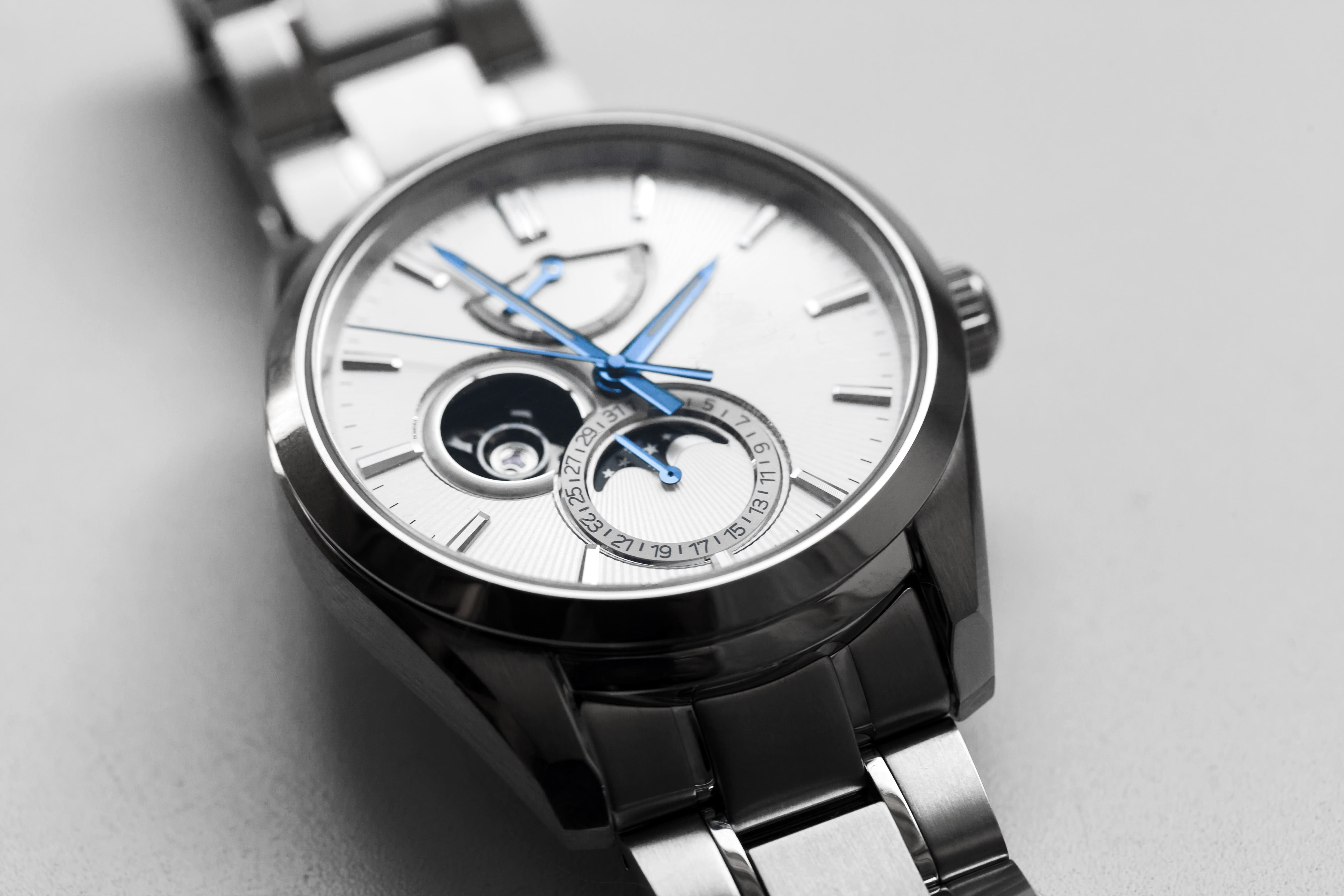
Moonphases range from discreet subdials to dramatic centre-stage displays. Materials such as aventurine glass, enamel, or laser-engraved metal add depth and texture, elevating the complication beyond mere function. Jaeger-LeCoultre exemplifies refined execution through restraint rather than spectacle. In models like the Master Control Chronograph Calendar and the Master Ultra Thin Moon, the manufacture integrates a polished, moon against a deep blue or silvered sky, framed by precise typography and balanced dial architecture. The result is a moonphase that feels elegant and timeless—visually expressive without overwhelming the watch’s overall harmony—underscoring Jaeger-LeCoultre’s reputation for subtle sophistication and design discipline.


Q: Which Movement Type Is Best—Mechanical, Quartz, or Solar?
Your preference depends on intent:
Mechanical (Automatic or Manual-Winding):
For collectors, this remains the gold standard. The moonphase is most compelling when it’s driven by finely finished gears and levers rather than electronics. Patek Philippe, Jaeger-LeCoultre, Arnold & Son, IWC, and Ulysse Nardin are particularly respected for their mechanical executions.
Quartz:
Quartz moonphase watches can be extremely accurate and convenient, often requiring little more than an occasional adjustment. Brands like Longines and Baume & Mercier offer elegant, well-proportioned designs at accessible price points.
Solar / Eco-Drive:
Less common in traditional Swiss luxury, these watches combine quartz precision with long-term practicality, appealing to wearers who value ease of ownership over mechanical romance.
Q: Which Brands Are Best for
Moonphase Watches?
At Humbertown Jewellers, you’ll find a carefully selected range of moonphase watches that showcase different philosophies of execution:
Patek Philippe – Benchmark-setting precision and classical elegance
Jaeger-LeCoultre – Balanced, refined moonphases rooted in movement innovation
IWC – Clean, architectural interpretations, especially in the Portugieser line
Arnold & Son – Large-scale, expressive moonphase displays with historical influence
Ulysse Nardin – Bold, technically inventive designs, including three-dimensional moon representations
Omega – Robust moonphases integrated into contemporary sports-luxury watches
Longines – Well-designed, accessible luxury options
Panerai – A modern, assertive take on an otherwise classical complication


Q: Is a Moonphase Watch
Right for Me?
If you appreciate mechanical nuance, visual storytelling, and complications that exist as much for pleasure as for function, a moonphase watch is a compelling addition to any collection. Whether expressed through the restrained precision of a Patek Philippe or the sculptural drama of an Arnold & Son or Ulysse Nardin, the moonphase remains one of horology’s most evocative complications.
A moonphase watch isn’t just about telling time—it’s about tracking celestial rhythm through mechanical artistry. Humbertown Jewellers offers an exceptional selection of moonphase watches, each chosen for its technical integrity, design merit, and long-term collectability.
